
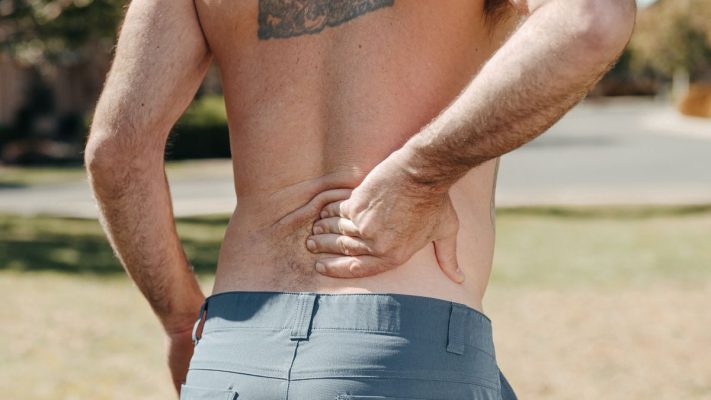
Spondylolisthesis means one vertebra has slipped forward on the one below it, most often at L4-L5 or L5-S1. It sounds alarming, but most people with a low-grade slip live active lives, and a strength-based programme is the main treatment.
Need help? Read about our back pain treatment in Dublin, or book an appointment in Dublin 2 or online.
| Most common levels | L5-S1 (isthmic) and L4-L5 (degenerative) |
|---|---|
| Key symptoms | Low back pain with standing or arching back, tight hamstrings, sometimes leg symptoms |
| Main treatment | Core and hip strength, activity changes, gradual return to sport |
| Typical improvement | 8 to 12 weeks of consistent rehab |
| Surgery | Mainly for high-grade or progressing slips, or persistent nerve symptoms |
Types and causes
- Isthmic: a stress fracture in the pars interarticularis (spondylolysis) lets the vertebra slip. Common in young athletes in sports with repeated back extension, such as gymnastics, cricket fast bowling, rugby and diving.
- Degenerative: wear in the discs and facet joints allows slipping, usually over 50 and more often in women. Often occurs with spinal stenosis.
- Less common types: congenital, traumatic and post-surgical.
Grades
| Grade 1 | Up to 25% slip |
|---|---|
| Grade 2 | 25 to 50% |
| Grade 3 | 50 to 75% |
| Grade 4 | Over 75% |
Most people have grade 1 or 2, which usually respond well to conservative treatment.
Symptoms
- Lower back pain, often worse when standing, walking or arching backwards
- Tight hamstrings and a feeling that the back is unstable or catching
- Pain, tingling or heaviness into the buttocks or legs
- Leg symptoms on walking that ease with sitting, when stenosis is also present
Seek urgent medical care if: you have numbness around the groin, bladder or bowel changes, or worsening leg weakness.
How is it diagnosed?
A standing X-ray shows the slip and its grade; flexion and extension X-rays can show if it moves. An MRI is used when there are nerve symptoms. A young athlete with low back pain on extension may need a scan to check for a pars stress fracture.
Treatment
- Core and hip strengthening to control the spine, progressing to loaded exercises
- Reducing repeated or heavy back extension while symptoms settle
- Hamstring and hip mobility work
- Coached return to sport and lifting, with technique changes where needed
- Hands-on treatment and, for degenerative cases, walking and weight management
What you can do at home
- Start with gentle core exercises such as dead bugs, bridges and side planks from the knees
- Avoid sleeping on your stomach and long periods standing with your back arched
- Stay active with walking, cycling or swimming
Outlook
The slip itself usually stays the same, and in adults it rarely progresses. Pain and function can improve a lot as strength and control improve.
Frequently asked questions
Can spondylolisthesis be reversed?
No, but most people become pain-free or close to it with the right programme.
Can I go to the gym?
Yes. Strength training is one of the best treatments, with the right exercise choice and technique.
How do I sleep with spondylolisthesis?
On your side with a pillow between your knees, or on your back with a pillow under your knees.
Will it get worse?
In adults it rarely progresses. Teenagers with isthmic slips are monitored while still growing.
Videos that will help
- Real patient: lumbar spondylolisthesis recovery without surgery
- How to manage retrolisthesis without surgery
- Best home exercises with a resistance band for lower back pain
Related conditions
Related articles
Annular Tear at L4-L5 and L5-S1 L4–L5 & L5–S1 Disc Rehabilitation in Dublin Can a Disc Bulge Heal
Get expert help
Not improving, or want a plan built around your scan and goals? Book an assessment at our Dublin 2 clinic or online from anywhere.
General information only; it does not replace an individual assessment.
Not in Dublin? Recover with Bob online.
Follow Bob’s step-by-step rehab plans in the Bob the Physio app, or work with him 1:1 on a flexible monthly online programme. See real recovery stories from 1,000+ people.
References
- Kalichman L, Hunter DJ. Diagnosis and conservative management of degenerative lumbar spondylolisthesis. Eur Spine J. 2008;17(3):327-335. Link
- Meyerding HW. Spondylolisthesis. Surg Gynecol Obstet. 1932;54:371-377.
- National Institute for Health and Care Excellence (NICE). Low back pain and sciatica in over 16s: assessment and management (NG59). 2016, updated 2020. Link