
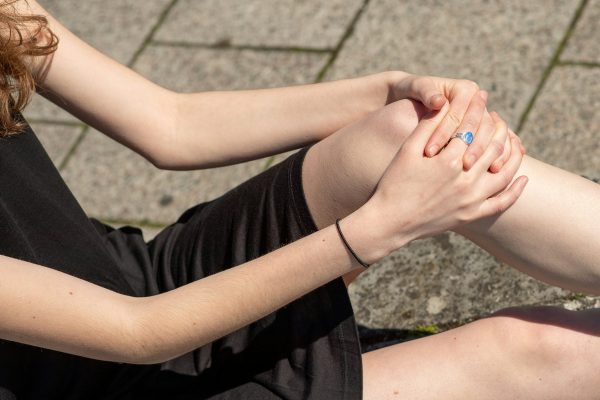
Pain just below your kneecap that comes on when you jump, land, squat or climb stairs is often patellar tendinopathy, better known as jumper’s knee. It is common in basketball, volleyball, GAA, football and running, and it responds best to a structured loading plan rather than complete rest.
Need help? Read about our knee pain treatment in Dublin, or book an appointment in Dublin 2 or online.
| What it is | An overload problem of the tendon that joins the kneecap to the shin bone |
|---|---|
| Who gets it | Jumping and sprinting athletes, often aged 15 to 30 |
| Key symptoms | Pain at the bottom of the kneecap with jumping, landing, squats and stairs |
| Main treatment | Load management and progressive tendon loading, from isometrics to jumping |
| Typical improvement | About 12 weeks; longer for long-standing cases |
What causes it?
The patellar tendon stores and releases energy every time you jump or change direction. When that load rises faster than the tendon can adapt, it becomes painful and less able to cope. Common triggers include:
- A sudden increase in training, matches or jump volume
- A change of surface, especially to harder courts
- Returning to sport after a break
- Reduced quadriceps and calf strength
Symptoms
- Pain at one spot just below the kneecap
- Pain at the start of training that may ease once warm, then returns afterwards
- Pain when sitting for a long time with bent knees, or on stairs
- Pain on single-leg squats or decline squats
See a doctor promptly if: your knee is hot, red and swollen, you have a fever, the knee locks or gives way, or you felt a sudden pop with immediate weakness.
How is it diagnosed?
Diagnosis is mainly clinical: pain that sits right at the tendon and increases as the tendon is loaded, such as on a single-leg decline squat. Ultrasound or MRI may be used if the picture is unclear or not improving, but scan changes in the tendon are also common in players without pain.
Treatment
- Load management: adjusting jumping, sprinting and training volume, not stopping everything
- Isometric holds such as wall sits or leg-press holds to ease pain
- Heavy slow resistance exercises to build tendon capacity
- Energy storage work: skipping, hopping and jumping, gradually reintroduced
- Return to sport plan with clear milestones
- Shockwave therapy for persistent cases
What you can do at home
- Use a pain-monitoring rule: up to 3 out of 10 during exercise that settles by the next morning
- Do isometric wall sits (5 x 45 seconds) before training on sore days
- Keep your strength work going through the season
- Avoid sudden jumps in training, especially at the start of a season
Outlook
Most players improve with a well-structured programme, though tendons respond slowly. Patience and consistency usually beat rest, injections or passive treatments alone. If your pain is more around the kneecap, read our guide on fat pad pain below the kneecap.
Frequently asked questions
Should I stop playing with jumper’s knee?
Not always. Many players keep training at a reduced load. Pain up to about 3 out of 10 that settles by the next day is usually acceptable.
Is jumper’s knee the same as runner’s knee?
No. Jumper’s knee hurts at the tendon just below the kneecap. Runner’s knee (patellofemoral pain) is more around or behind the kneecap.
Do knee straps help?
A patellar strap can ease pain during sport for some people, but it does not fix the tendon. Strength work does.
How long does patellar tendinopathy take to heal?
Most people improve over 12 weeks of progressive loading. Long-standing cases can take 6 months or more.
Videos that will help
Related conditions
Related articles
Hoffa’s Fat Pad Treatment in Dublin Meniscus Tear Management Knee Lateral Collateral Ligament Rehabilitation
Get expert help
Not improving, or want a plan built around your goals? Book an assessment at our Dublin 2 clinic or online from anywhere.
General information only; it does not replace an individual assessment.
References
- Malliaras P, et al. Patellar tendinopathy: clinical diagnosis, load management, and advice for challenging case presentations. J Orthop Sports Phys Ther. 2015;45(11):887-898.
- Breda SJ, et al. Effectiveness of progressive tendon-loading exercise therapy in patients with patellar tendinopathy: a randomised clinical trial. Br J Sports Med. 2021;55(9):501-509.
- Rio E, et al. Isometric exercise induces analgesia and reduces inhibition in patellar tendinopathy. Br J Sports Med. 2015;49(19):1277-1283.