
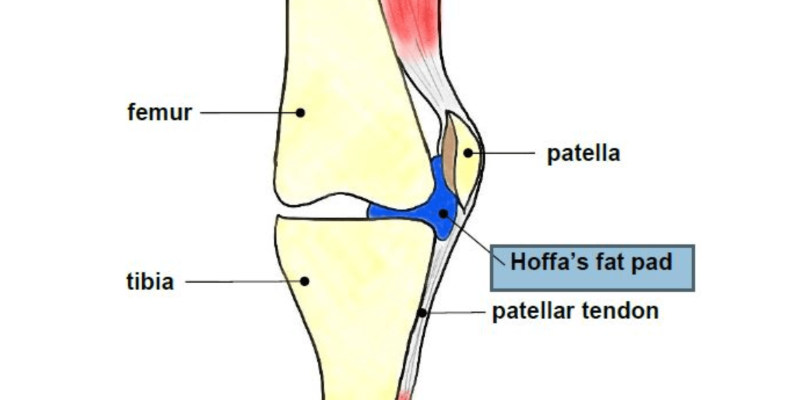
Pain at the front of your knee, particularly just below the kneecap? Discomfort when standing, walking or fully straightening your knee may be associated with irritation of the infrapatellar fat pad, also called Hoffa’s fat pad.
However, several knee conditions can cause similar symptoms. An assessment helps clarify the likely source and appropriate treatment.
At Dublin Sports Injury Clinic in Dublin 2, we provide knee assessments, personalised treatment and progressive rehabilitation to help you work towards comfortable daily activity and exercise.
Book your knee pain assessment
What is Hoffa’s fat pad syndrome?
Hoffa’s fat pad is a normal soft-tissue structure at the front of your knee, beneath the kneecap and behind the patellar tendon.
It contains many nerve endings and can become painful when irritated, injured or repeatedly compressed.
You may hear this condition described as:
- Hoffa’s fat pad syndrome.
- Infrapatellar fat pad impingement.
- Knee fat pad syndrome.
- Hoffa’s syndrome.
Common symptoms
Symptoms may include:
- Pain just below the kneecap.
- Tenderness beside the patellar tendon.
- Local swelling at the front of the knee.
- Pain when fully straightening or over-straightening the knee.
- Discomfort during prolonged standing, walking or stairs.
Symptoms alone do not confirm the diagnosis. Patellar tendinopathy, patellofemoral pain and other knee conditions can overlap.
What can contribute to fat pad irritation?
Symptoms may follow a direct injury to the front of the knee or develop gradually with repeated loading.
Repeatedly pushing the knee beyond its normal straight position—known as hyperextension—can aggravate the fat pad in some people.
At your assessment, we explore your history, activity changes and the movements that reproduce your symptoms. We also consider whether another knee structure may be involved.
When should you book an assessment?
Consider an appointment if:
- Pain keeps returning or is not improving.
- Standing or walking has become uncomfortable.
- Knee symptoms are limiting work, running or gym training.
- You are unsure which exercises are suitable.
- Previous treatment has not helped sufficiently.
- An MRI report mentions fat pad swelling or impingement.
Book an assessment at Dublin Sports Injury Clinic
What happens at your first appointment?
We begin by listening to your symptoms, concerns and recovery goals.
Review your history
We discuss when the pain started, previous injuries or surgery, activity levels and any treatment you have tried.
Assess your knee
Your physical examination considers knee movement, strength, tenderness and relevant tasks such as walking or stepping.
Explain the findings
We explain the likely source of your symptoms and whether further investigation or medical assessment is appropriate.
Plan your rehabilitation
Your clinic consultation includes appropriate treatment to help manage symptoms, practical advice and a personalised rehabilitation plan.
We discuss your likely recovery pathway and explain how progress will be reviewed.
How is Hoffa’s fat pad syndrome managed?
1. Modify painful loading
Initial management commonly involves adjusting activities or positions that repeatedly aggravate symptoms.
For some people, this includes reducing painful knee hyperextension or temporarily adapting training. The aim is to find manageable activity and rebuild from there.
2. Develop strength and movement control
Rehabilitation may include quadriceps and hip strengthening, alongside exercises to improve control of the knee.
Your exercise range, resistance and progression should reflect your symptoms and ability.
3. Consider taping where appropriate
Taping may help reduce symptoms in selected people. We can assess your response and explain whether it is useful alongside your exercise programme.
4. Gradually return to your goals
As your symptoms and ability improve, we work towards the demands of your daily life and exercise.
We review what you can do, how your knee responds afterwards and whether your programme needs adjusting.
Explore our knee pain assessment and treatment service
Why choose Dublin Sports Injury Clinic?
Your rehabilitation should fit your life.
At our Dublin 2 clinic, we help you understand the assessment findings and give you practical guidance for the activities you find difficult.
Whether your goal is walking more comfortably, managing a physical job or returning to sport, we build your plan around that goal and review your progress.
Frequently asked questions
Do I need an MRI?
Not everyone needs a scan. Your history and examination guide whether imaging would be useful.
MRI can show fat pad changes, but these findings must be interpreted alongside your symptoms. A scan finding alone does not establish that the fat pad is causing your pain.
Is this the same as runner’s knee?
No. Hoffa’s fat pad syndrome involves the infrapatellar fat pad. Runner’s knee commonly refers to patellofemoral pain.
Their symptoms can overlap, which is why an assessment matters.
Should I avoid straightening my knee?
You do not need to permanently avoid normal knee straightening. Painful hyperextension may need temporary modification, with movement rebuilt according to your response.
Can I continue going to the gym?
Bring your routine to your appointment. We can help you review exercise choices, range and resistance, then discuss suitable progression.
How long does recovery take?
There is no single timeline. We discuss expectations after assessing your symptoms, daily demands and previous treatment, then review your progress.
Does fat pad impingement require surgery?
Conservative management is usually the starting point. Persistent symptoms may require specialist assessment to review the diagnosis and further options.
When should I seek urgent medical advice?
Seek urgent assessment if your knee becomes hot and swollen with fever, or an injury leaves you unable to bear weight or straighten the knee.
Sudden major swelling, deformity or a genuinely locked knee also needs prompt medical review.
Book knee pain treatment in Dublin 2
If pain below your kneecap is affecting walking, work or exercise, we can help you understand the problem and plan your next steps.
At Dublin Sports Injury Clinic, we provide individual assessments, appropriate treatment and personalised rehabilitation.
This article provides general education and does not replace an individual assessment.
References
- Dragoo JL, Johnson C, McConnell J. (2012). Evaluation and treatment of disorders of the infrapatellar fat pad.Sports Medicine, 42(1), 51–67.
- Draghi F et al. (2016). Hoffa’s fat pad abnormalities, knee pain and magnetic resonance imaging in daily practice.Insights into Imaging.
- NHS Dorset. Hoffa’s fat pad syndrome. Musculoskeletal Matters.